There is a file on someone's desktop right now called something like manuscript_v4_final_REVISED_kt_comments_2.tex. It arrived as an email attachment. It holds three people's edits, two of which were merged by hand, and at least one paragraph that a co-author already deleted once and which has quietly come back from the dead.
This is not an unusual way to write a paper. For a lot of research groups it is the normal way.
Versioning is really a coordination problem
The obvious diagnosis is a file management failure. People should use version control, the tooling exists, problem solved.
That diagnosis is wrong, or at least useless. Most researchers are not going to adopt git for prose, and telling them to is not a plan. The deeper issue is that when a document lives in one person's copy at a time, collaboration becomes turn based.
Turn based collaboration has costs that compound:
- Work gets serialised. Your co-author has the file, you wanted to fix the related work section, so you wait or you make a copy and create the merge problem yourself.
- Feedback arrives too late to act on. A supervisor reading a draft two weeks after it was written is commenting on decisions that have already hardened. The same comment during drafting would have taken a minute to apply.
- Edits vanish silently. Manual merging fails in a particularly nasty way, because the failure is invisible. Nobody notices the deleted paragraph came back until a reviewer asks why the introduction contradicts the discussion.
- Nobody knows the current state. The most common question on a multi author paper is some version of "is this the latest one?", and the fact that it needs asking is the whole problem.
What changes when there is one document
Real time editing removes the coordination problem by removing its premise. There is one document, everyone is in it, and the "latest version" question stops existing because there is no version to be behind.
In TeXposit that means unlimited collaborators editing at once, with each other's cursors visible and changes appearing as they happen.
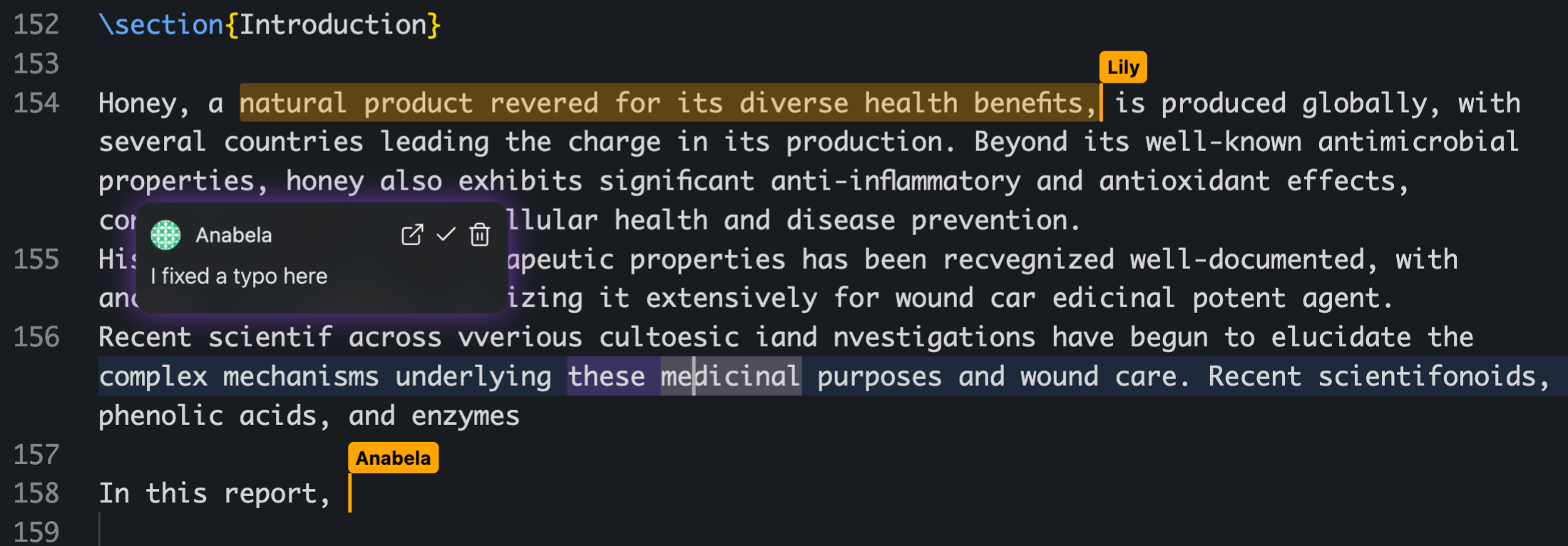
The live cursors are mostly a novelty after the first day. What actually matters is what becomes possible once the document is continuously shared. A co-author fixes your equation while you are still writing the paragraph around it. A supervisor comments on a sentence the moment you write it. Someone works on the bibliography while someone else restructures section three, and neither waits for the other.
The paper stops being a baton that gets passed and starts being a room people are in.
Four things it has to get right
Real time editing is easy to demo and hard to be trusted with. A manuscript is not a shared shopping list. People need to believe the tool will not eat six months of work.
Nothing can be silently lost. Every TeXposit project is a git repository and every save is a commit attributed to whoever made it. Concurrent editing without a durable, attributed history is a trust problem waiting to happen. "It syncs" is not the requirement. "You can always get it back" is.
Disagreement needs somewhere to go that is not the text. If the only way to object to a sentence is to change it, collaboration turns into an edit war. Comments and inline suggestions let a co-author propose instead of impose, and the section's author decides. This matters more the steeper the hierarchy. A first year PhD student should be able to flag that their supervisor's paragraph is wrong without having to overwrite it.
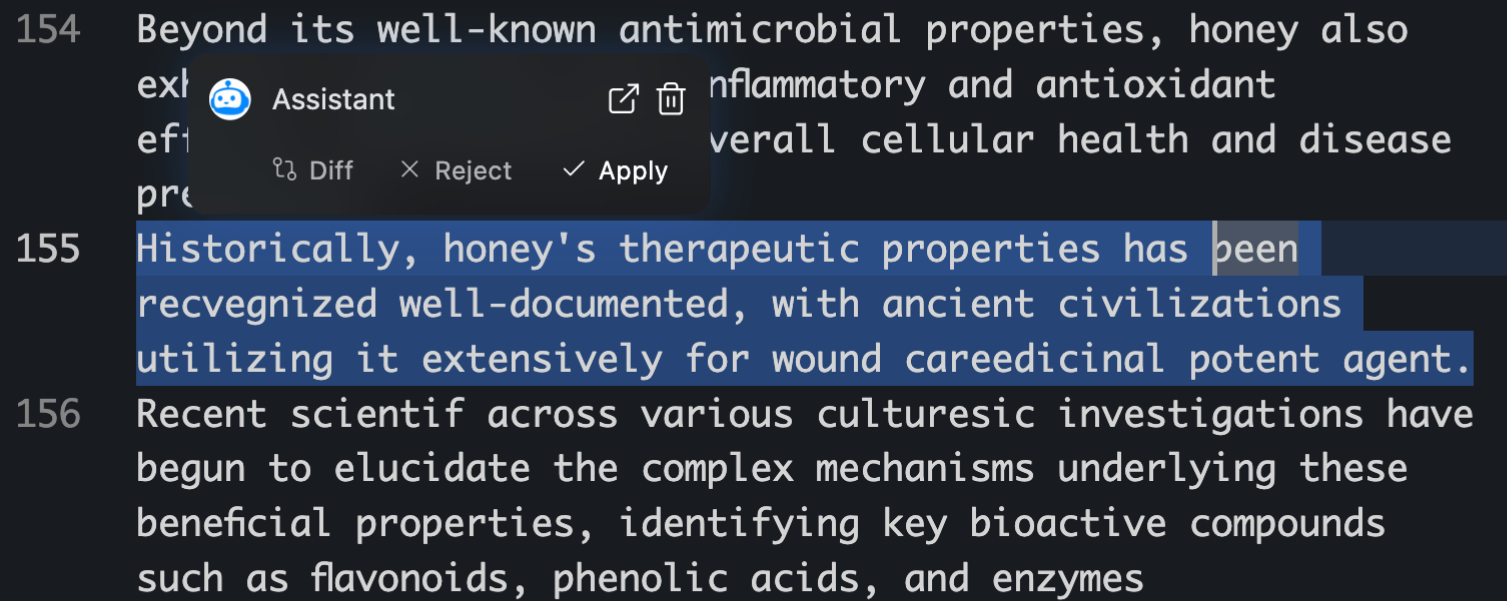
Attribution has to survive. When five people write a paper together, who wrote what gets genuinely hard to reconstruct, and increasingly someone will ask. Per contributor history and provenance records mean the answer exists without anyone keeping notes by hand.
It cannot require everyone online at once. Most collaboration is asynchronous. Real time editing should make the synchronous case work well without making the asynchronous case worse, which means history, comments, and notifications matter at least as much as live cursors do.
The unglamorous conclusion
Nobody picks a writing tool because it has real time collaboration. That has been table stakes since Google Docs.
What is still not table stakes is having it alongside a real LaTeX toolchain, with unlimited collaborators, durable attributed history, and a comment system that lets people disagree without fighting over the text. Any one of those on its own is a feature. Together they are the difference between a tool that can hold a manuscript and one that cannot.
Real time collaboration with unlimited collaborators is free. See the collaboration guide to get started.